
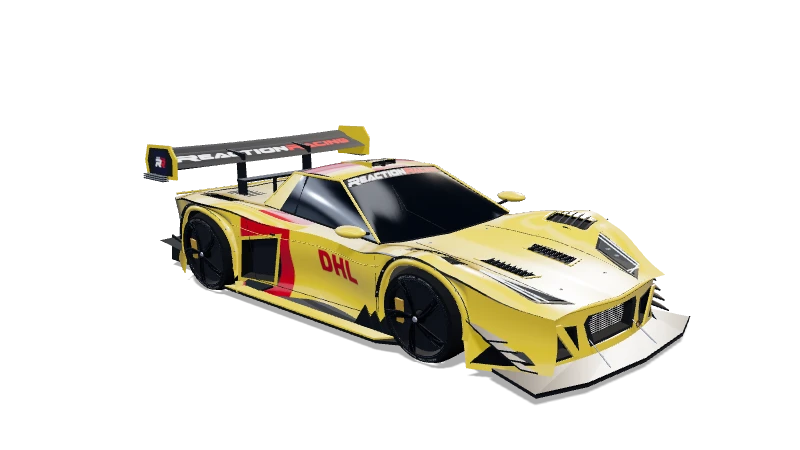
Understand ReactionRacing tournament entry, qualification stages, schedules and advancement. Check each official event’s rules before joining the grid.
A tournament is not just a cup with a larger title. It connects entry requirements, a sequence of rounds and an advancement rule. Before joining, you need to know which event you are eligible for, when its races happen and what result keeps you in the competition. Reading those three things is more useful than memorising a generic bracket.
Start with the actual event, not an example format
The competition calendar lists official published records from the game. Open an event to see its format, start time, rank requirement, capacity, entry cost and prize description. The event page is a public guide; joining and viewing personal results happen inside the app.
Do not assume that every event has the same number of rounds, seats or advancing drivers. Those are properties of the specific competition. A six-round example with a twenty-driver final helps explain a format, but it is not a universal rule. When the schedule includes round-level seats and advancement counts, read those values for your event.
Entry: separate availability from eligibility
An event can be published without being available to join immediately. Its status distinguishes announced, open, full, racing and finished states. A place on the public calendar is not a reservation, and an open event may still have a rank or other eligibility requirement.
Free-to-play describes access to the game. It does not mean every competition has identical entry conditions. Some event records specify free entry; others can specify a Race Credit cost. Check the actual entry field and the in-app confirmation before committing. Race Credits are in-game items with no cash value, not a promise of a monetary return.
Qualification and rounds: know what advances
Once entered, follow the assigned schedule in the app. Qualification establishes the starting grid for a race; the tournament's advancement rule establishes which drivers continue after the relevant stage. These are different decisions. A strong qualifying response helps your starting position, but it does not by itself award passage into a later round.
During the races, normal turns determine progress and can create wheel-to-wheel opportunities. Attack and defence challenges then test controlled slides and timing. A competitive tournament result therefore depends on more than a single fast reaction. Repeated clean execution, car development and resource decisions all contribute to the races that feed the standings.
If your event advances a specified number of drivers from each group, check your position against that cutoff. If the rule or a tie is unclear, use the published event conditions and official in-app result; do not infer an undocumented tiebreaker from the order of names on a promotional page.
Read times carefully
The public website labels event times in UTC. Convert them to your local time before planning a session, especially when your region changes clocks. A tournament's overall start date is not necessarily the start time of its final. Read each scheduled round, not only the first date on the card.
Leave enough time to open the app and inspect the current event state. Refresh the public event page if you are returning to an old bookmark: schedules and status are read from the game rather than frozen at the date a website article was written. A disappeared or unpublished event should not silently show details for a different competition.
Results: use the right leaderboard
Your event's results, points and progression belong to that competition. The public driver boards answer other questions: fastest race average, career average within a rank band, calibrated Reaction Index skills and Racecraft. Leading a skill board does not mean you lead the tournament, and winning a tournament does not require first place in every performance domain.
After a race, compare the official result with your goal. Were points lost through an unsafe slide, a missed cue or a poor resource choice? The battle review helps distinguish those mistakes. Use the short warm-up before a subsequent session to practise the specific action, not to chase an unrelated record.
A useful pre-entry check
- Open the exact event and read its current status.
- Check rank requirements, any entry cost and available places.
- Check the round dates, time zone and advancement rule.
- Read the prize conditions and the official result location.
- Join through the app and verify the event appears in your own schedule.
That is the route from interest to a real place on the grid. The public calendar helps you choose; the event's published rules and in-app standings determine what happens next.